
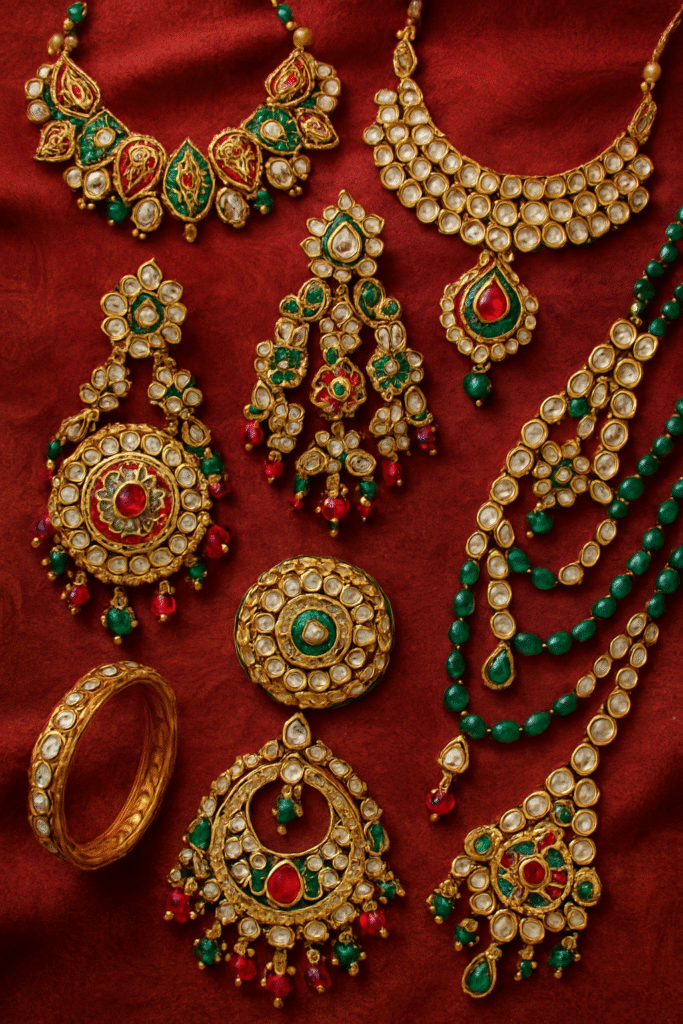
Rajasthan, the land of kings and queens, has been India’s jewelry capital for over 400 years. From the bustling lanes of Jaipur’s Johari Bazaar to the royal workshops of Udaipur, this desert state has crafted some of the world’s most exquisite jewelry pieces.
The Rich Heritage of Rajasthani Jewelry
Historical Significance
Rajasthani jewelry traditions date back to the Mughal era when royal patronage flourished under emperors like Akbar and Shah Jahan. The influence of Persian, Central Asian, and indigenous Indian styles created a unique aesthetic that defines Rajasthani jewelry today.
Cultural Importance
In Rajasthani culture, jewelry isn’t just ornamental—it’s symbolic. Each piece tells a story, represents social status, and carries deep cultural meaning. From a bride’s chooda to a queen’s elaborate necklace, every ornament has significance.
Traditional Rajasthani Jewelry Styles
1. Kundan Jewelry
What is Kundan?
Kundan is the purest form of gold jewelry where gems are set in gold foil. This ancient technique, practiced for over 2,500 years, creates stunning pieces with uncut diamonds and precious stones.
Characteristics:
Uses 24-karat gold foil
Features uncut diamonds (polki)
Intricate enamel work on the reverse (meenakari)
Heavy, elaborate designs
Popular Kundan Pieces:
Chandbali earrings
Choker necklaces
Maang tikka
Passa (side head jewelry)
2. Meenakari Work
Meenakari is the art of coloring and ornamenting the surface of metals through enameling. This Persian technique was brought to Rajasthan and perfected by local artisans.
Process:
Base metal preparation
Engraving intricate patterns
Applying colored enamel
Firing at high temperatures
Multiple layers for depth
Color Significance:
Red: Represents love and passion
Green: Symbolizes new beginnings
Blue: Signifies peace and tranquility
White: Indicates purity
3. Jadau Jewelry
Jadau is an ancient jewelry-making technique where precious stones are embedded in gold without the use of any adhesive.
Unique Features:
No glue or chemicals used
Stones held by gold pressure
Reversible designs
Extremely durable construction
4. Polki Diamonds
Polki refers to uncut, raw diamonds in their natural state, maintaining their organic form.
Why Choose Polki:
Unique, irregular shapes
Natural brilliance
Each piece is one-of-a-kind
Rich, antique appearance
City-Specific Jewelry Styles
Jaipur – The Pink City’s Golden Legacy
Specialty: Kundan and Meenakari work
Famous For: Elaborate bridal sets, temple jewelry
Signature Style: Intricate patterns with precious stones
Jodhpur – Royal Blue City Elegance
Specialty: Heavy traditional sets
Famous For: Chandbali earrings, thick gold necklaces
Signature Style: Bold, statement pieces
Bikaner – Desert Finesse
Specialty: Delicate filigree work
Famous For: Lightweight daily wear jewelry
Signature Style: Intricate metalwork with minimal stones
Udaipur – City of Lakes Luxury
Specialty: Royal-style heavy jewelry
Famous For: Temple jewelry, ceremonial pieces
Signature Style: Grand designs with precious stones
Modern Trends in Rajasthani Jewelry
Contemporary Adaptations
Today’s designers are reimagining traditional Rajasthani jewelry for modern lifestyles:
Fusion Designs:
Traditional motifs in contemporary settings
Lightweight versions of heavy pieces
Mix of traditional and modern metals
Versatile pieces for day and night wear
Sustainable Practices:
Ethically sourced materials
Recycled gold usage
Support for local artisans
Eco-friendly packaging
Digital Age Influence
The digital revolution has transformed how Rajasthani jewelry reaches customers:
Virtual try-on technology
Custom design consultations online
Direct artisan-to-customer connections
Social media inspired designs
How to Identify Authentic Rajasthani Jewelry
Quality Indicators ?
Hallmark Certification: Look for BIS hallmarks on gold pieces
Craftsmanship Details: Hand-finished pieces show slight variations
Weight: Authentic pieces have substantial weight
Documentation: Proper certificates and guarantees
Red Flags to Avoid
Unusually low prices
Missing certifications
Poor finishing quality
Reluctance to provide guarantees
Conclusion
Rajasthani jewelry represents more than mere ornamentation—it’s a living testament to India’s rich cultural heritage. Whether you’re seeking a timeless bridal set or a contemporary piece with traditional roots, understanding these traditions helps you make informed choices.
As the jewelry industry evolves digitally, platforms like Johari Bazar are making authentic Rajasthani jewelry more accessible while preserving the artisan traditions that make each piece special.
Ready to explore authentic Rajasthani jewelry? Join our digital marketplace launching February 2025 and connect directly with master craftsmen and verified dealers.